Alif Laila was initiated into the Indian Classical music by late Ustad Mir Qasem Khan, nephew of the legendary Ustad Alluddin Khan, in Dhaka , Bangladesh . There she imbibed the style of the Senia Maihar Gharana,(school of music). Influenced by many eminent Indian Classical musicians who have enhanced her abilities as a musician are teachers such as Partha Chatterjee and Pandit Krishna Bhatt, both disciples of late Pandit Nikhil Banerjee, one of the foremost sitar player of all times. She also has the good fortune of having the blessings and guidance from “Sur Samrat”( the king of melody), Ustad Ali Akbar Khan.She has performed extensively since 1988 in Classical Sitar. In January 2001 she gave a solo recital in The National Museum of Bangladesh, where she was accompanied by the tabla virtuoso, Pandit Anindo Chatterjee.The titles of her CD recordings are, Devotion, The Inner Voice, (tabla accompaniment by Pandit Anondo Chatterjee) and Meditation with Sitar, a recording of Alaap, Jor and Jhala. In the words of her guru, Pandit Krishna Bhatt,” Alif Laila is one of the most impressive female Sitarists, who conveys the bhav (emotion) of ragas with profound sensitivity”. She has taught Sitar at the University Of Maryland and also teaches a number of students in...
Music
On Saturday, May 3rd, Chhandayan will present Rajan and Sajan Mishra at The Universities at Shady Grove Conference Center, Building 1, 9630 Gudelski Drive, Rockville MD.
News & Media
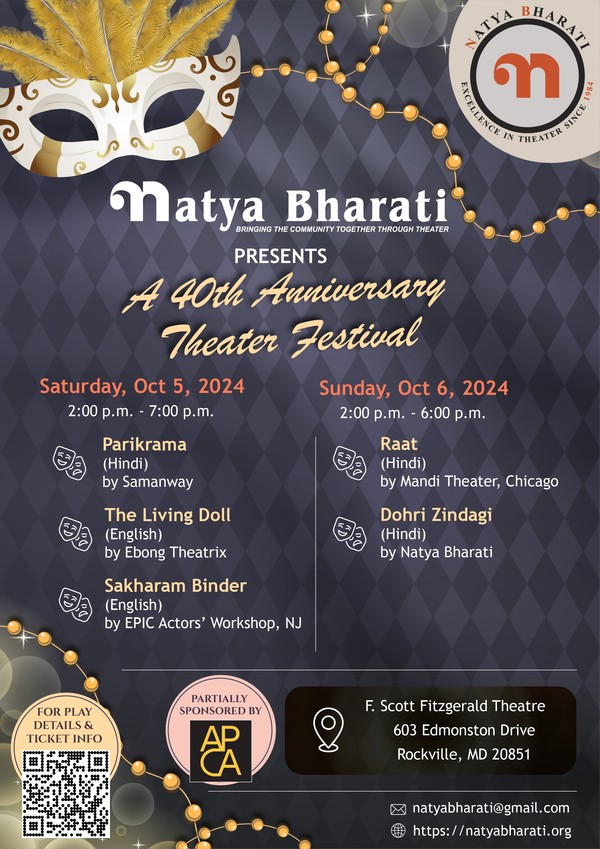
APCA keeps the Indian spirit alive in America by Nivedita Mookerji Sunday, March 21, 1999 This is about an Indian in the US trying to keep his roots alive. Through an organisation called Advancement and Promotion of Charitable Activities (APCA). Now APCA has been around for over one year, and Jatinder Kumar is its trustee. The focus being art and theatre, APCA supports anything from an art exhibition on women in Indian cinema to storytelling and performances of folk-tales from India. It could even be a show of Deepa Mehta’s Fire or a group discussion on Kiran Desai’s works or an introduction to Odissi dance.Jatinder Kumar spoke about APCA’s objectives in an on-line interview. Explaining how APCA is run, he says: “I, as trustee, head the activities of APCA. There are two other board members who help me in the selection of activities that APCA should support.” “APCA is funded from the investment income of an estate left by one of my relatives,” states Kumar. Since APCA is registered by the US Internal Revenue Service as a public charity, he depends upon a certain amount of support from thepublic every year to keep APCA tax exempt. The public support is usually in the form of a minimum annual donation of $100 per person. Such a donation makes that person a `Friend of APCA’, which means he gets preferred seating in ticketed shows and cultural events supported by APCA. Plus, all the information regarding the coming events is mailed to him much in advance. He also receives special invitations to meet artists in person. And for the largest five donors, it’s a chance to become honorary advisors to help select future artists for sponsorship. Explaining the mission of APCA, Jatinder Kumar says: “Basically, I look forward to promoting the excellence of Indian art, music and theatre.” In addition to underwriting Indian events at the Smithsonian, National Geographic and other international institutions that are free to the general public, he supports local and visiting Indian artists throughout the year.Commenting on the uniqueness of APCA, he says: “I believe APCA is the first public charity of its kind in this country, which is self-supporting and is dedicated...
The Narrative Thread
The Narrative Thread: Women’s Embroidery From Rural India Showcases Revived Art Form That Enhances Women’s Lives: On View at The National Museum of Women in The Arts Februray 4- May 9, 1999. Washington, D.C.-The Narrative Thread: Women’s Embroidery from Rural India, at the National Museum of Women in the Arts from February 4 through May 9, 1999, will examine the revival and reinvention of a quilting tradition. The 30 communally created quilts depict stories on topics ranging from village life and Hindu epics to health care and women’s rights. Women of India’s rural eastern Bihar state are again creating the colorful, embroidered quilts (sujunis) first made by their predecessors in the 18th century. But these modern textiles depart from the past in technique, materials, and colors. Perhaps most remarkably, the stories that the women choose are contemporary statements that provide not only a source of social freedom, but also of economic empowerment. The quilts in this exhibition combine the arts of quiltmaking and embroidery. They were designed by three women from the Bihar village of Bhusura: Archana, Nirmala Devi, and Reenu. After sketching a story freehand on cotton cloth, the designer narrates it to the three or four women who will embroider the sujuni. These women may suggest changes to the story or in the design. They then outline the design in chain stitches, color the figures with brilliant threads, and fill in the white background with running stitches to give a rippling, vibrant texture to the whole quilt. The main narrative appears at the center of the quilt, with one or two motifs or another stage in the narrative lining the borders. Some quilts, such as Bamboo and Fishing in the River, use themes from everyday activities in and around the village. In others, women’s issues predominate, such as Girls’ Education and Marriage with Dowry and Without, the latter illustrating the panchayats, meetings the women hold to seek their own solutions to community problems. In Rich Woman, Poor Woman, a poor woman begs from a rich woman, then starts her own job and finds success. Quilts also address the spread of AIDS, female infanticide, wife abuse, and voting rights for women. One of...
Ramblings
INTIMATE ENCOUNTERS WITH MUSIC: THE NORTH INDIAN BAITHAK Interaction between musicians and their audiences is an essential constituent of any successful Indian classical music performance. Musicians often mention how important audiences responses are to them during the the process of performing, where this rapport helps direct their elaboration of a specific raga or musical mode. Audiences express their responses to the music they hear through gestures as well as audible exclamations such as “vah vah!”, “kya baat hay!”, and “subhan allah”, which are equivalent to the expressions”well done!”, or “beautiful!”. These exclamations are made within the performance itself, directly following any particularly pleasing, innovative or proficient passage of music. Not only these responses make the musician feel that their music is being appreciated, they also allow the musician to gauge the audience’s musical sophistication as well as identify particularly knowledgeable listeners. The specific type of performance setting that allows this intimate interaction between musicians and their audiences in North India is called a baithak. The word baithak implies a small gathering where everyone is seated in an Indian fashion, on the floor. A baithak can be a gathering assembled to hear a religious or philosophical discourse or, in our case, a sort of musical discourse, an elaboration of music through a performance. The word baithak can also refer to the specific architectural spaces where these gatherings take place, be it a specific room laid out with carpets and cushions, or a kiosk where outdoor performances are held. Paintings depicting musical performances are some of the most important sources for reconstructing the history of baithaks. The practice of intensely listening to a performance for its musical rather than its religious value probably began in the courts of Sultan rulers during the very period after the twelfth century. During that period, poet musicians such as Amir Khusro were developing the instruments and musical forms that constitute what we now call Hindustani classical music. It was not until the sixteenth century rule of the Mughal emperor Akbar that miniature paintings include depiction of musical gatherings at court. Akbar’s capital of Fatehpur Sikri includes a red sandstone platform set in the middle of a pool where we might...